
by The League of Women Voters of La Plata County Healthcare Committee
America is facing a worsening healthcare crisis — and millions of people are paying the price right now. When Congress failed to extend ACA premium subsidies and the One Big Beautiful Bill was signed into law in July 2025, the consequences hit fast. Nearly 5 million people lost their insurance in 2026 alone. Millions more are still technically “covered” but facing premiums that have doubled — some jumping over 114% — making coverage feel like an impossible luxury. For some insured people, the deductibles are so high, it feels prohibitive to even visit a doctor when ill.
And it’s going to get worse before it gets better. By 2034, an estimated 15 million Americans could lose their health coverage entirely. These aren’t just numbers — they’re children, pregnant women, seniors, veterans, people with disabilities, and working adults who did everything right but still fell through the cracks. Rural families are watching their local hospitals teeter on the edge of closure. People on Medicaid are losing coverage not because they’re ineligible, but because new paperwork requirements are tripping them up. Workers who thought they were protected are discovering the safety net has a hole in it.
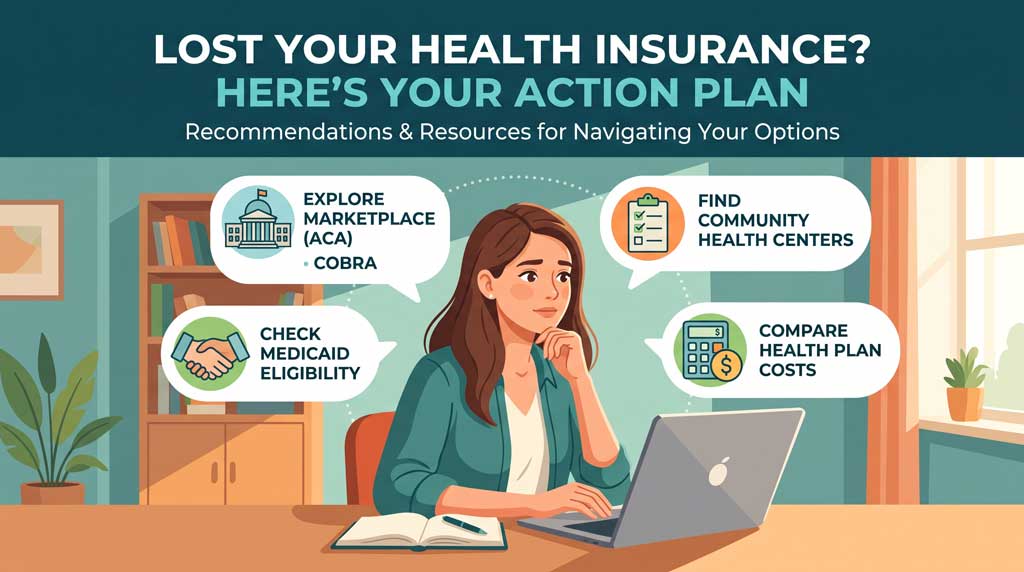
If you’ve lost your insurance, seen your premiums become unaffordable, had your Medicaid disrupted, or lost coverage through your job — you are not alone, and you are not out of options. Here’s what you can do right now.
First — Don’t Skip Coverage Entirely If You Can Avoid It
Even a bare-bones plan is worth investigating before you go fully uninsured. Even a high-deductible plan can protect you from medical bankruptcy if the absolute worst-case scenario happens.
Medicaid Work Requirements: Starting January 2027, Medicaid enrollees will need to prove they meet new challenging work requirements or risk losing coverage. The nonpartisan Congressional Budget Office (CBO) estimates this will cause 5.3 million people to lose Medicaid and become uninsured by 2034. Many analysts think the real number will be higher. The Center on Budget and Policy Priorities estimates 9.9 to 14.9 million people are at risk of losing coverage — largely due to red tape, not because they’re failing to work.
States are still building the IT systems and hiring the staff needed to verify work status around the new rules. In the meantime, many people could lose coverage simply because they struggle to navigate confusing state eligibility portals, not because they’re ineligible.
Check these options first:
- HealthCare.gov / Connect for Health Colorado. With one application, you can find out if you’re eligible for a Marketplace health plan, Medicaid, or CHIP. Even with subsidy changes, you may still qualify for reduced-cost plans depending on your income.
- Medicaid & CHIP — If your income is low, you may qualify. Medicaid covers low-income adults, children, pregnant women, and people with disabilities. CHIP covers children in families that earn too much for Medicaid but still need help.
- COBRA — If you lost your job, COBRA allows you to maintain health coverage temporarily after your employment ends. It’s often expensive since you pay 100% of the premium, but it preserves continuity of care. HealthCare.gov
Watch Out for Fake Insurance
As you search for coverage, be wary of plans that look like insurance but aren’t. Red flags include: too-good-to-be-true monthly premiums, no coverage for pre-existing conditions, morality clauses, or a lack of mental health coverage. Some short-term plans and health-sharing ministries leave people with enormous bills when they need care most. Always read the fine print.
Tap Every Source of Low- or No-Cost Care
Let Your Care Team Know You’re Uninsured
Doctors, nurses, and pharmacists often know workarounds that can help you get care even when you can’t afford it. For example, they should be able to tell you which local pharmacies have $4 generics or which nonprofits cover certain medications. Talk openly about money with your doctor — healthcare providers can make adjustments if they know you’re worried about cost. A doctor might order an ultrasound instead of a more expensive MRI. Prices are often negotiable; you just have to ask.
Ask Your Doctor for Medication Samples
Many drug companies give samples to medical providers as part of their sales pitch. Doctors are often very open to sharing these with patients who let them know they’re struggling with costs. If you have a good relationship with your provider, don’t be shy about asking — health is more important than pride.
Use Free and Charitable Clinics
The National Association of Free & Charitable Clinics offers a navigator tool to find free or low-cost care near you. Services like Remote Area Medical operate pop-up clinics offering medical, dental, and vision care throughout the country. These clinics depend on charitable donations — if you can afford to support them, please consider it.
Federally Qualified Health Centers (FQHCs)
FQHCs are one of the best-kept secrets for uninsured patients. Community health centers like Axis Health, locally, offer routine and non-emergency care — flu, infections, checkups, dental and mental health care — on a sliding scale based on your income. They serve 52 million patients annually in some of the country’s most underserved areas. Search for one near you at findahealthcenter.hrsa.gov.
Academic Medical Centers
Academic Medical Centers tend to have more robust charity care programs for uninsured patients and can often refer you to specialists willing to work with patients who lack coverage.
Your Local Health Department
Health services vary by county, but many offer free vaccinations, family planning, and testing for STIs, flu, COVID, and tuberculosis. Some counties also offer dental services and mental health or substance abuse programs. The CDC’s National Breast and Cervical Cancer Early Detection Program makes free or low-cost screenings available to low-income women in all states and territories.
Seek Out Mutual Aid
Mutual aid efforts have grown significantly since the COVID-19 pandemic and have become a powerful way to weather hard situations like being uninsured. Search for mutual aid networks in your area or for a specific disease or community — for example, there are active mutual aid networks for Type 1 diabetics. Mutual aid can help with sharing information about low-cost medical care and where to find the cheapest prescriptions when paying out of pocket.
Know Your Billing Rights
Under the No Surprises Act, uninsured (or self-pay) individuals are entitled to a “good-faith estimate” of medical items or services before receiving care. There is also a patient-provider dispute resolution process if you receive a bill substantially greater than what was estimated. Don’t hesitate to ask for this estimate upfront — it’s your right.
Getting Affordable Medications
This is one area where uninsured patients can find real savings:
Ask your pharmacist directly — pharmacies have collections of discount programs they can run through to find the best price, but you have to ask. Different drugs have different prices across these programs.
Comparison tools — Sites like GoodRx, WellRx, and SingleCare let you shop and compare prices. Even without insurance, showing a free coupon from these services at the pharmacy can yield steep discounts.
Low-cost generics — Retailers like Walmart, Target, and Costco sell 90-day prescriptions of many generic drugs for around $10.
Cost Plus Drug Company (costplusdrugs.com) — A newer option offering dramatically discounted generic medications.
TrumpRx.gov — A recently launched federal resource with special offers and low prices for certain prescription drugs outside of Marketplace coverage.
Manufacturer assistance programs — Many drugmakers offer patient assistance programs, coupons, and rebates — for example, the Lilly Insulin Value Program offers insulin for $35 to uninsured patients. Check the manufacturer’s website directly. These programs are no substitute for simply lowering drug prices, but they can help in the short term.
NeedyMeds.org — Lists programs that may provide patients with financial assistance for medications.
Coupons and “co-pay cards” from drugmakers
Brand-name drugmakers often offer cards and coupons that can help knock down your co-pay on expensive drugs. Your pharmacist may do a search for you. Or you can Google your drug’s name, plus “co-payment card.” And the nonprofit NeedyMeds.org has a search tool.
But: People who are on Medicare, Medicaid, Tricare, and VA healthcare can’t use these cards, because of a federal law.
Coupons from GoodRx and other sites
These are discounts negotiated through middleman companies like pharmacy benefit managers. And especially for generic drugs, they can offer a better deal than your insurance.
But: When you use these coupons, your insurance doesn’t kick in — and your payment doesn’t count toward your deductible.
Discount pharmacies: Online and off
Mark Cuban’s Cost-Plus Drugs is the best-known online shop here. But alternatives like Amazon, Walmart, Costco, and others are worth checking out. NeedyMeds.orghas a list of in-person pharmacies with lists of $4 generics.
Caveat: With Mark Cuban’s site and some others, it’s like GoodRx: You don’t use your insurance, so what you pay doesn’t count towards your deductible.
Patient Assistance Programs
Drugmakers offer these to folks based on financial need. Again, NeedyMeds has a search tool.
But: Each program sets its own criteria for “financial need,” which can be strict, and the application process can take a lot of time and energy, but may be worth it.
International online pharmacies
There are pharmacies in Canada that ship to the U.S. It’s technically illegal to import drugs, but the FDA says it’s basically OK to bring in up to a 90-day supply for yourself. Recently, in June of 2026, the FDA approved Colorado to buy drugs from Canada.
But: Do some due diligence, to make sure the supplier is legit. You can use the tool PharmacyChecker to verify international online pharmacies and compare prices.
Be your own advocate on prescription drugs
Insurers sometimes recommend drugs that benefit their bottom line more than your health. You and your doctor are the real experts. If a cheaper formulation, like a tablet instead of a capsule, works just as well, ask about switching. It’s not unusual to see price differences that can be five times more for no medical benefit.
Diagnosis-Specific Resources
If you have a specific condition, there may be dedicated help available:
The Patient Advocate Foundation (patientadvocate.org) maintains a vetted list of foundations that can help offset medical bills and provide resources like transportation and lodging — just enter your age, location, and diagnosis.
Disease-specific nonprofits (e.g., American Cancer Society, Susan G. Komen, Lupus Foundation) can connect you to free or low-cost care and sometimes cover portions of treatment costs.
Clinical Trials — The NIH and National Cancer Institute maintain lists of trials that can provide access to treatment. Ask upfront about any associated costs before enrolling.
Know When the ER Is Your Safety Net
If you run out of a life-sustaining medication or experience a medical emergency, don’t hesitate to go to the ER. Under federal law (EMTALA), ERs must evaluate and stabilize you regardless of insurance status. They can provide an emergency supply of essential medications like insulin. They are not a long-term solution, but they can save your life.
That said, avoid the ER when possible — it remains the most expensive place to receive care and routinely leaves uninsured patients with large bills. Use free clinics, FQHCs, or urgent care as alternatives for non-emergency situations.
The situation is genuinely difficult right now — healthcare spending in the U.S. rose 7.2% between 2023 and 2024, amounting to over $15,000 per person — but these resources exist specifically to help people navigate a system that can otherwise feel overwhelming. You are not alone, and there are people and organizations whose entire mission is to help you find care.