
Claims that American elections are rigged or stolen rank among the loudest in politics right now. If that worries you, you deserve an answer based on facts, not talking points. Misinformation about elections doesn’t just mislead voters; it erodes both democracy and the trust the whole system depends on, which makes getting the facts right a civic responsibility.
Voter fraud is real, but rare, and existing safeguards consistently catch and prosecute it before it changes an outcome. The strongest evidence comes from a source with every reason to find the opposite. The Heritage Foundation, a leading conservative think tank, maintains the country’s most comprehensive database of proven U.S. election fraud cases and built it to argue for stricter voter ID and registration laws. Heritage staff had to search back decades to assemble it. The small numbers of fraud that they found is telling.
Researchers at the Brookings Institution ran Heritage’s own data in October 2024. In Arizona, over 25 years and 36 elections, fraud came to just 0.0000845% of all ballots cast. In Pennsylvania, Heritage found 39 cases across 30 years and more than 100 million votes. Nationally, Heritage’s database documents roughly 1,500 cases over five decades, but nowhere close to anything organized or large enough to change a major election.
Mail voting draws most of the fraud talk, so let’s start with who actually uses it.
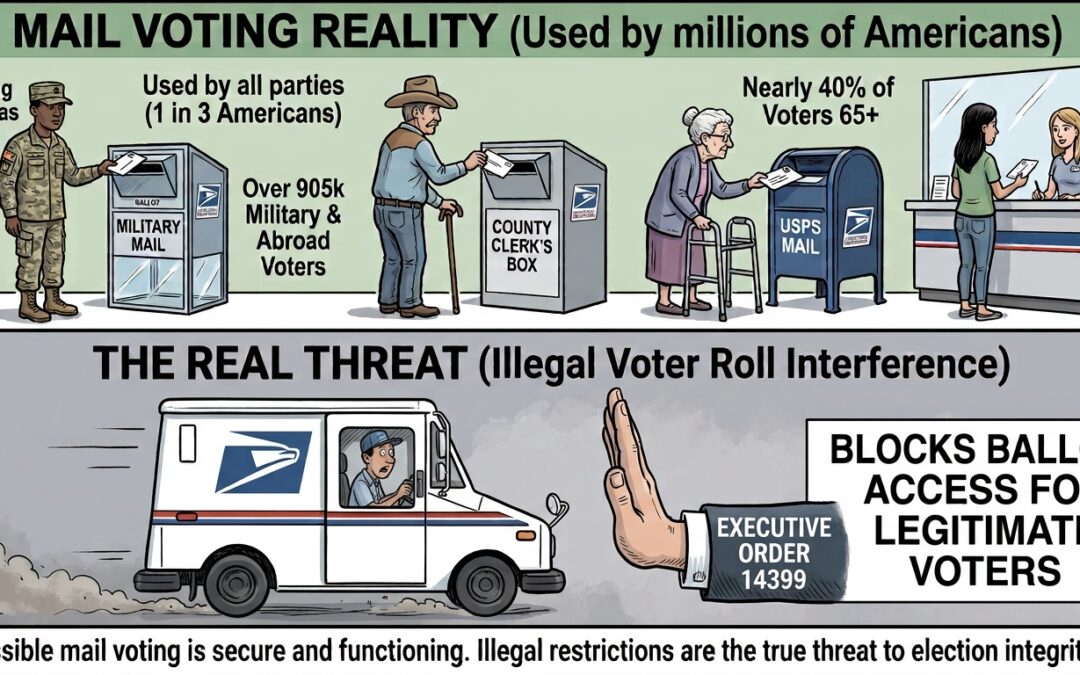
Nearly one in three Americans voted by mail in 2024, per the U.S. Election Assistance Commission. That includes one in five registered Republicans and one in four registered Democrats. More than 905,000 military members and Americans living abroad returned mail ballots in 2024 according to the States United Democracy Center. Voters 65 and older cast nearly 40% of their ballots by mail, and in Colorado, every registered voter gets one automatically. Mail voting isn’t a partisan tool; it’s how seniors vote when driving is hard, how ranchers, 40 miles from a polling place, vote and how service members and Americans living overseas vote.
Mail voting now faces an active real threat and the situation shifted in the past weeks. On March 31, 2026, President Trump signed Executive Order 14399, which directs the Postal Service to build a federally approved list of mail voters and refuse to deliver ballots from anyone left off it. Article I, Section 4 of the Constitution gives states and Congress authority over election rules, not the president. This puts millions of legitimate voters at risk of losing access to mail ballots.
On August 11, a federal judge in Massachusetts blocked the Postal Service from implementing that section, in a suit brought by the League of Women Voters and other nonpartisan groups. On August 24, the Supreme Court stayed a separate injunction in a case brought by state attorneys general, holding only that the challenge came too early and declining to rule on whether the order is lawful. The Massachusetts court then vacated its August 11 injunction on that same narrow reasoning. USPS made its final rule effective August 21. Plaintiffs refiled, and on August 26 the court granted a 14-day temporary restraining order against the new rule. Twenty-four states and D.C. filed suit the same day.
Before you rely on any of this, check lwv.org or the Colorado Secretary of State. The case is moving week to week.
Slow results are not evidence of fraud. In Colorado, ballots have to reach the county clerk by 7 p.m. on Election Day. The clerk’s office then has a set period to finish counting, receive qualifying military and overseas ballots, and let voters fix signature problems. Bipartisan teams of election judges review ballots that entire time. The La Plata County Clerk and Recorder publishes the process, and you can watch it happen. Election night numbers are projections. The certified count is what counts.The final result may vary from election night projections, but as any sports fan will tell you, it’s not over until it’s over.
After the 2020 election, Trump’s own vice president, attorney general, and senior campaign staff stated on the record and under oath that they saw no fraud large enough to change the result. Trump and his allies filed 62 post-election lawsuits. Courts rejected 60 of them for lack of evidence, including courts with judges he had appointed himself.
No scheme exists that could rig a national election. Isolated problems do happen. Someone forges a registration form. Someone tries to vote twice. Signature verification, bipartisan poll watchers, post-election audits, and Colorado’s statewide ballot tracking exist to catch exactly that, and they do.
Go to the La Plata County Clerk and Recorder’s office, and walk through how ballots are handled, and sign up for BallotTrax to follow your own ballot from mailing through counting.
The real threat to election security 2026 is public trust rather than tampering. It’s the erosion of trust in a system that, by the best available evidence across the political spectrum, is functioning. Protecting that trust means demanding honesty from candidates, from media, and from ourselves. And, refusing to let misinformation fill the space facts should occupy.
Your vote counts. And so does the truth about how it’s protected.
League of Women Voters La Plata Board of Directors
Tara Kiene
Liz Mora
Adrea Bogel
Mady Miraglia
Jan Phillips
Wendy Pollak
Darlene Koontz
Eileen Maddox